Bangkok living costs · 8 October 2026 · ThaiHomeRB
One THB 15,900 two-bedroom apartment. Why does it feel affordable to one household and impossible to another?
A two-bedroom apartment advertised in Bang Sue asks THB 15,900 a month. For a household earning the 2023 middle income group's average of THB 31,384, rent alone would take about 51% of income, before food, commuting or children's costs. This is an illustration, not a recommendation to rent it. The real question is: how does the same housing choice change life for households at different income levels? NSO household groups
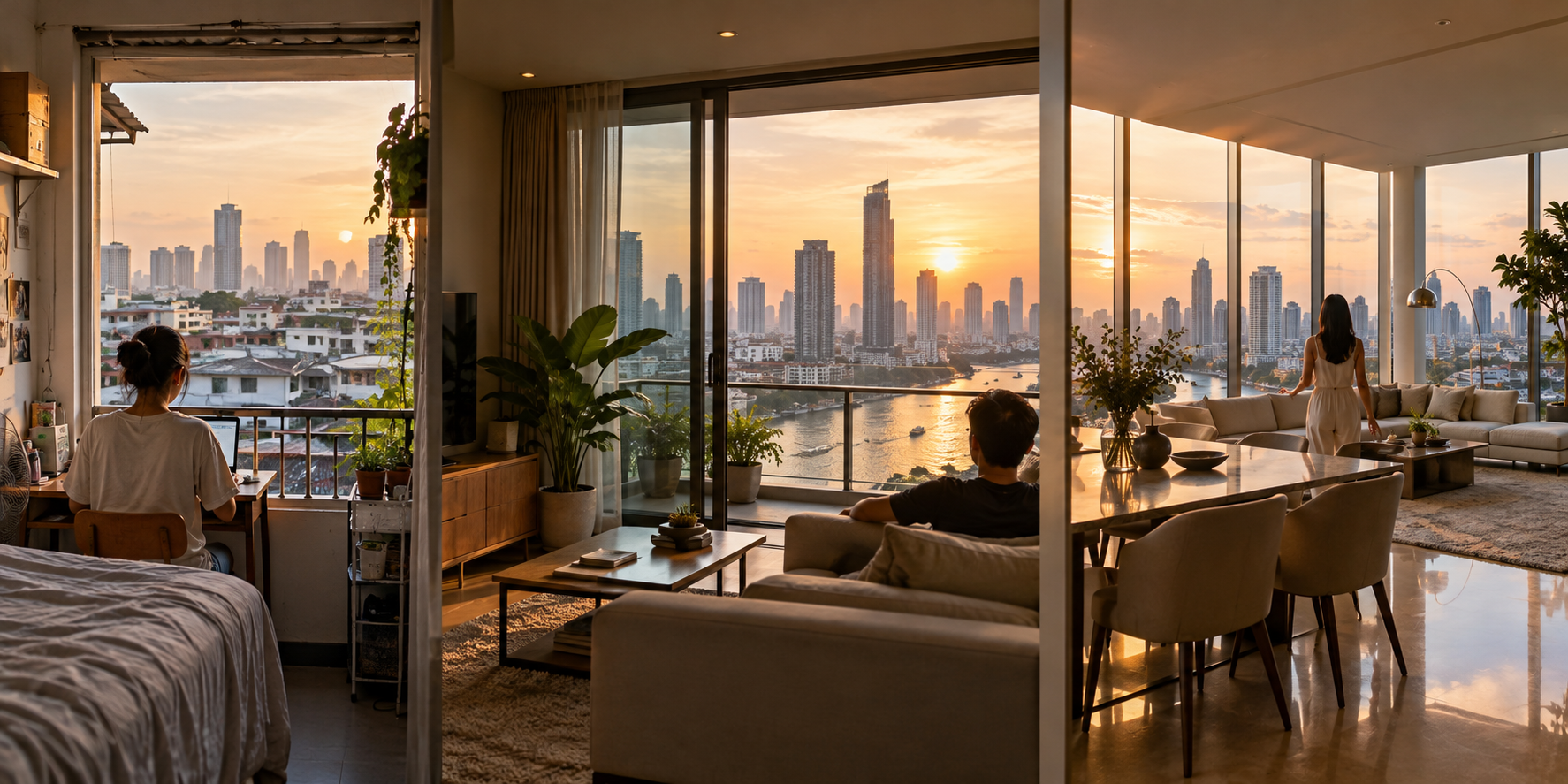
Original composite illustration, not a photograph of the households or listings discussed.
How much does it cost to live in Bangkok per month?
In Thailand’s 2023 household survey, households in Bangkok and three neighbouring provinces spent on average about THB 22,353 a month in the lowest income fifth, THB 27,435 in the middle fifth and THB 50,171 in the highest fifth. Your own figure depends mostly on household size, rent or ownership, children and commute.
There is no useful single “Bangkok monthly budget.” Household size, home ownership, children, work location and family support change the answer. Thailand's National Statistical Office (NSO) ranked households by regular income per person in its 2023 survey. The figures below select the lowest, middle and highest fifths for Bangkok plus Nonthaburi, Pathum Thani and Samut Prakan. These are actual group averages, not three invented families or 2026 price forecasts. NSO group table, spending categories
| Monthly 2023 average, THB per household | Lowest fifth | Middle fifth | Highest fifth |
|---|---|---|---|
| Income | 23,169 | 31,384 | 69,922 |
| Total expenditure | 22,353 | 27,435 | 50,171 |
| Household members | 3.20 | 2.15 | 1.87 |
| Food and non-alcoholic drinks | 9,475 | 9,448 | 11,572 |
| Housing-related | 5,337 | 6,610 | 13,200 |
| Transport | 2,647 | 3,778 | 9,235 |
| Medical | 220 | 263 | 969 |
| Education | 525 | 578 | 871 |
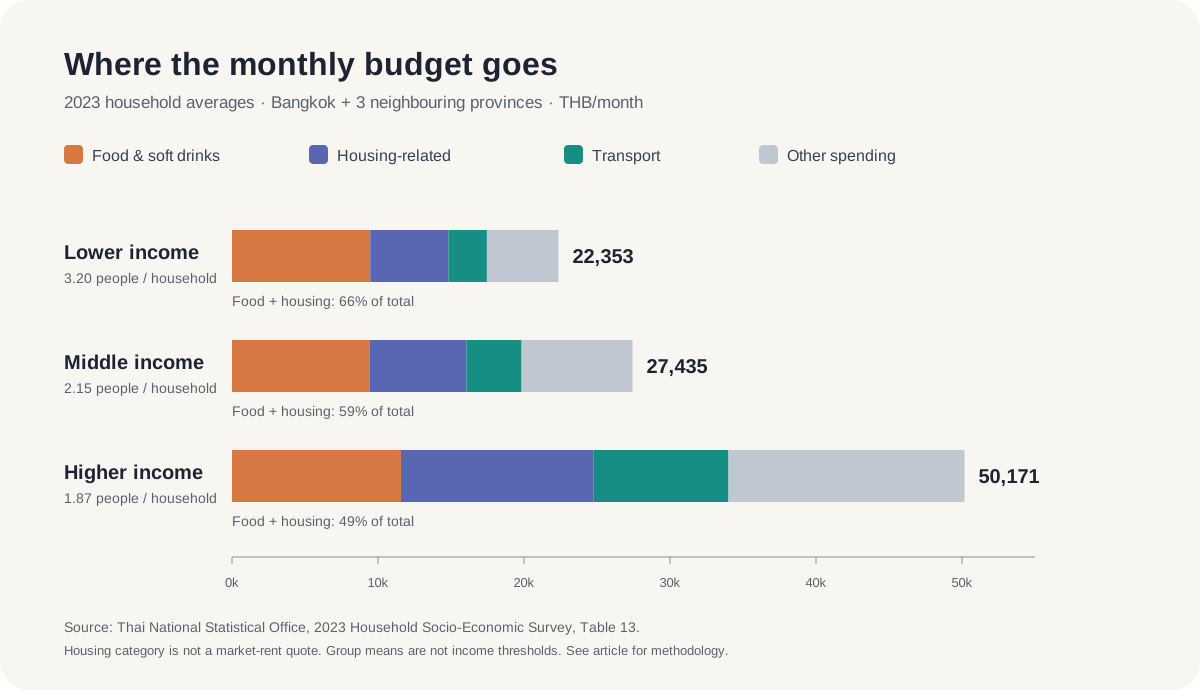
Chart: calculated from the NSO household and spending-category tables. Grey is all other expenditure, not disposable income.
The income figures are means within ranked groups, not entry thresholds. Housing-related spending is not a market-rent quote, and the difference between income and expenditure is not necessarily savings. Based on the NSO tables, food plus housing represents about 66% of total spending in the lowest group, 59% in the middle and 49% in the highest. The lowest group also has substantially more members on average. A low education average in the highest group does not make private schooling cheap: that group averages only 0.097 children per household. NSO household characteristics, category table
How much rent can a lower-income household in Bangkok afford?
Very little: in the lowest income fifth, food and housing alone average THB 14,812 of THB 23,169 monthly income. Advertised Bang Na studios start around THB 4,800–6,500 a month, but a studio is not suitable space for a three-person family, so predictable bills and the commute matter as much as the rent.
Food and housing together average THB 14,812 against group income of THB 23,169; transport adds THB 2,647. An advertised 32 m² Bang Na studio asks THB 4,800–6,500 monthly, with deposit and utilities to be confirmed. This demonstrates a price option, not suitable space for a three-person family. A Bangkok resident separately reported spending about THB 20,000 a month on the outskirts including THB 6,000 rent, but explicitly described himself as a frugal single person. His account cannot be used as a family budget. Resident discussion For a household, the meaningful tests are room size, predictable bills, access to work and school, affordable shopping and healthcare. A cheaper room with a punishing commute may offer poor value.
Can a middle-income household in Bangkok afford a two-bedroom condo?
Only with a squeeze. A 54 m² two-bedroom in Bang Sue advertised at THB 15,900 a month would take about 51% of the middle income fifth’s average income of THB 31,384, before utilities. Set a rent ceiling and the number of bedrooms you need first, then compare areas.
The middle fifth averages THB 31,384 income and THB 27,435 expenditure. A Bang Sue two-bedroom, 54 m² listing asks THB 15,900 monthly—about 51% of this group's mean income before utilities. It is an asking-price example, not a typical middle-class home. In a 2024 first-person account, a couple living in a 45 m² one-bedroom reported THB 10,000 rent, 2,000 utilities, 2,500 vehicle insurance/fuel, 1,500 mobile phones and 1,700 medical insurance: 17,700 in listed recurring costs. They said they could keep monthly spending, including food, below 35,000. They had previously paid a mortgage on an investment condo but said it was paid off by the time of the post; its historical instalment is undisclosed and must not be mixed into current spending. Couple's itemised account A different couple reported about THB 65,000 monthly in 2025, including 25,000 rent. Neither anecdote is the NSO group average. Second couple's account Households with children should choose a rent ceiling and required bedroom count before choosing a fashionable neighbourhood, then check actual work and school journeys.
How much do higher-income Bangkok households spend on housing?
The highest income fifth averages THB 13,200 a month on housing-related costs and THB 9,235 on transport, out of THB 69,922 income. A THB 50,000 two-bedroom in Watthana would still take about 72% of that average income.
The highest fifth averages THB 69,922 income and THB 50,171 spending. Housing-related spending is THB 13,200, and transport THB 9,235. “Highest fifth” still does not mean a luxury or international-school household. At the far upper end, a Bangkok resident reported that he and his partner spent roughly THB 150,000 monthly: THB 33,000 rent, 7,000 utilities/communications, 40,000 food, 30,000 entertainment, 30,000 supporting the partner's family and 10,000 health insurance. This is an unverified self-report, useful for showing how non-housing choices can dominate spending—not a group average. Itemised resident account A two-bedroom Watthana apartment advertised at THB 50,000 would consume about 72% of the highest fifth's mean income; that price only works for households further up the distribution, or with housing support.
Which Bangkok area should you live in: Bang Na, Bang Sue or Watthana?
It depends on your priority, not on a district ranking: Bang Na/Udom Suk for lower fixed rent when you work in the southeast, Bang Sue/Tao Poon for a two-bedroom near northern rail lines, and Watthana/Pridi Banomyong when a higher budget buys access to Sukhumvit.
A conditional viewing order, not a district league table: consider Bang Na/Udom Suk when fixed rent is the priority and work is southeast; Bang Sue/Tao Poon when a two-bedroom unit and northern rail connections matter; Watthana/Pridi Banomyong when a higher housing budget buys access to the Sukhumvit area. The three ads are not district medians. For each real option, compare rent, utilities, essential transport and children's fixed costs; list deposit and moving costs separately. Inspect the room and walk the route at commute time. Agents and owners can help by disclosing usable floor area, whether bedrooms are truly separate, all charges and the actual route to transit.
Methods: NSO group figures cover 2023 and the four-province metropolitan area. Listings and public accounts were reviewed on 8 October 2026. Asking rents are not achieved rents; forum accounts are unverified anecdotes.