Where Is Thailand’s Housing Market Heading? Risks and Opportunities in Q4
Bangkok, Samut Prakan and Pattaya | Q4 2026 observations and a 2027–2028 outlook
Author: Yao Xiang | Pen name: YYao
AI-assisted writing and charts | Research cutoff: 5 October 2026 | English edition: 6 October 2026
Thailand’s residential market is adjusting, with signs of improvement in some segments. Developers are reducing supply and some condominium sales indicators have recovered. That improvement does not yet establish that home prices will rise across the market.
For landlords, agents and buyers, three questions matter: are actual transactions increasing, can rent support ownership costs, and are a project’s advantages already reflected in its purchase price?
This article separates reported data from the author’s interpretation. Q3 has ended, but missing complete results are not filled with invented numbers. The outlook for Q4 and the following two years uses conditional scenarios without statistically uncalibrated probabilities.
Is Bangkok’s condo market recovering in 2026?
Partly. Knight Frank reported that 51.7% of Bangkok condo units launched in Q2 2026 were reserved in their launch quarter (45.3% in Q1), and REIC reported Q2 new condo sales up 19.5% year on year. That shows improvement in some segments, but reservations still have to turn into completed ownership transfers.
In data published on 27 August, Knight Frank reported a 51.7% launch-quarter reservation rate for Bangkok condominiums launched in Q2, compared with 45.3% in Q1. In H1, 8,501 units were launched and 3,994 were reserved in their respective launch quarters, producing an aggregate rate of 47.0%. The comparable full-year measure for 2025 was 51.6%. [1]
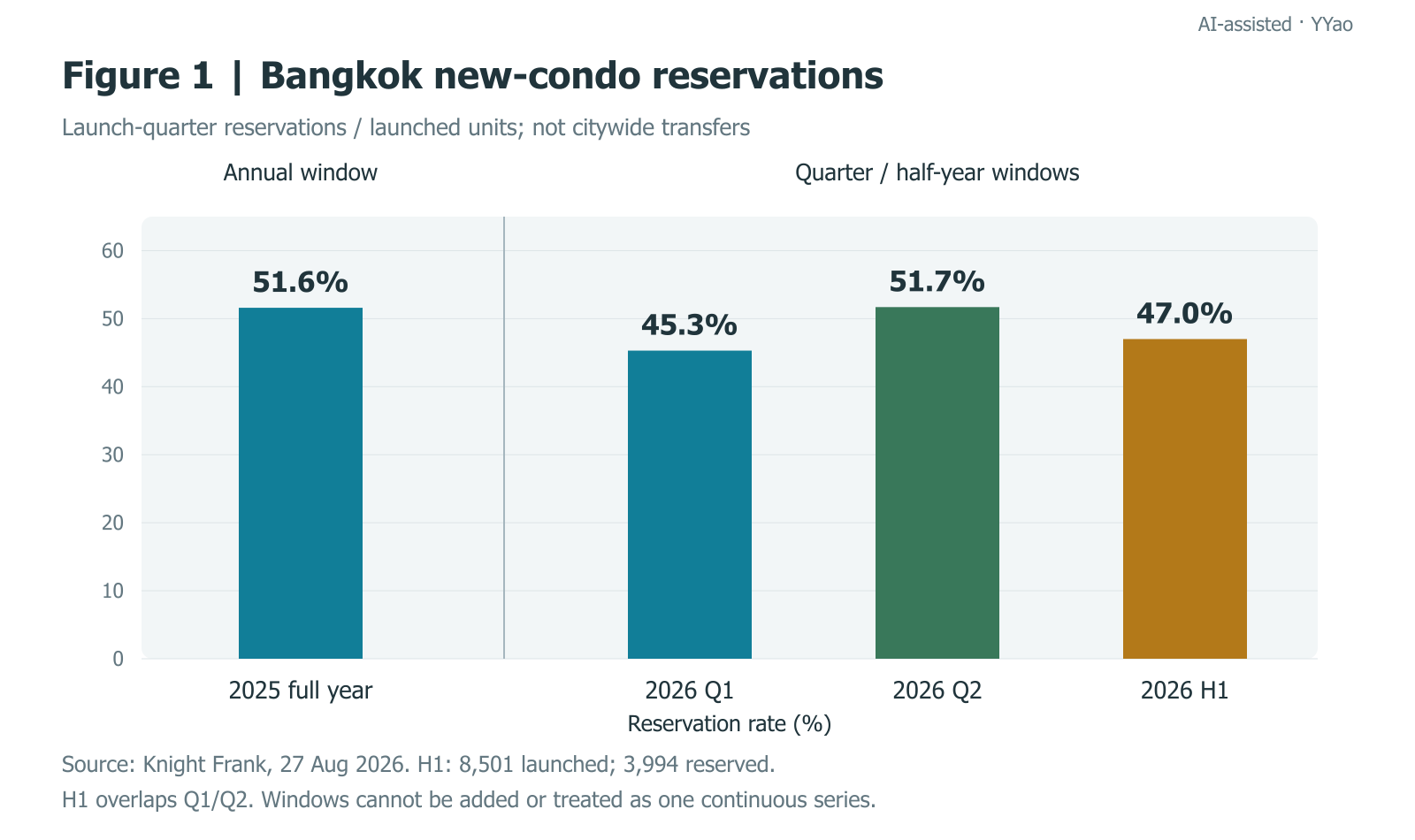
This measure describes performance within a new project’s launch window. It is neither a citywide transaction rate nor an ownership-transfer rate. Smaller launches, lower supply and more concentrated locations can all help improve reservation rates.
It would also be inaccurate to attribute every improvement to a smaller denominator. REIC’s 23 September press release stated that Q2 new condominium sales in Bangkok and five surrounding provinces rose 19.5% year on year. New sales across residential property increased 2.6%, while remaining unsold residential stock fell 10.2% to 202,414 units. [2]
My interpretation: supply contraction and pockets of stronger demand can occur together. The next test is whether reservations become completed transfers and whether improvement extends to more locations and price brackets.
Are foreign buyers still buying condos in Thailand?
Yes, but they are spending less. Foreign buyers took 14,899 condominium transfers nationwide in 2025, up 2.2%, while their total value fell 10.7% to THB 60.921 billion. Chinese buyers remained the largest group at 4,940 units, down 12.9%.
A report carried on REIC’s website, citing its statistics, recorded 14,899 condominium transfers to foreign buyers in 2025, up 2.2% year on year. Their total value was THB 60.921 billion, down 10.7%. [3]
Chinese buyers accounted for 4,940 units, down 12.9%. Myanmar buyers accounted for 1,968 units: unit volume rose 41.8%, but value fell 12.5%. Russian buyers accounted for 1,172 units, with volume rising 8.6% and value rising 30.3%. These are nationwide full-year figures, not Pattaya-specific statistics. [3]
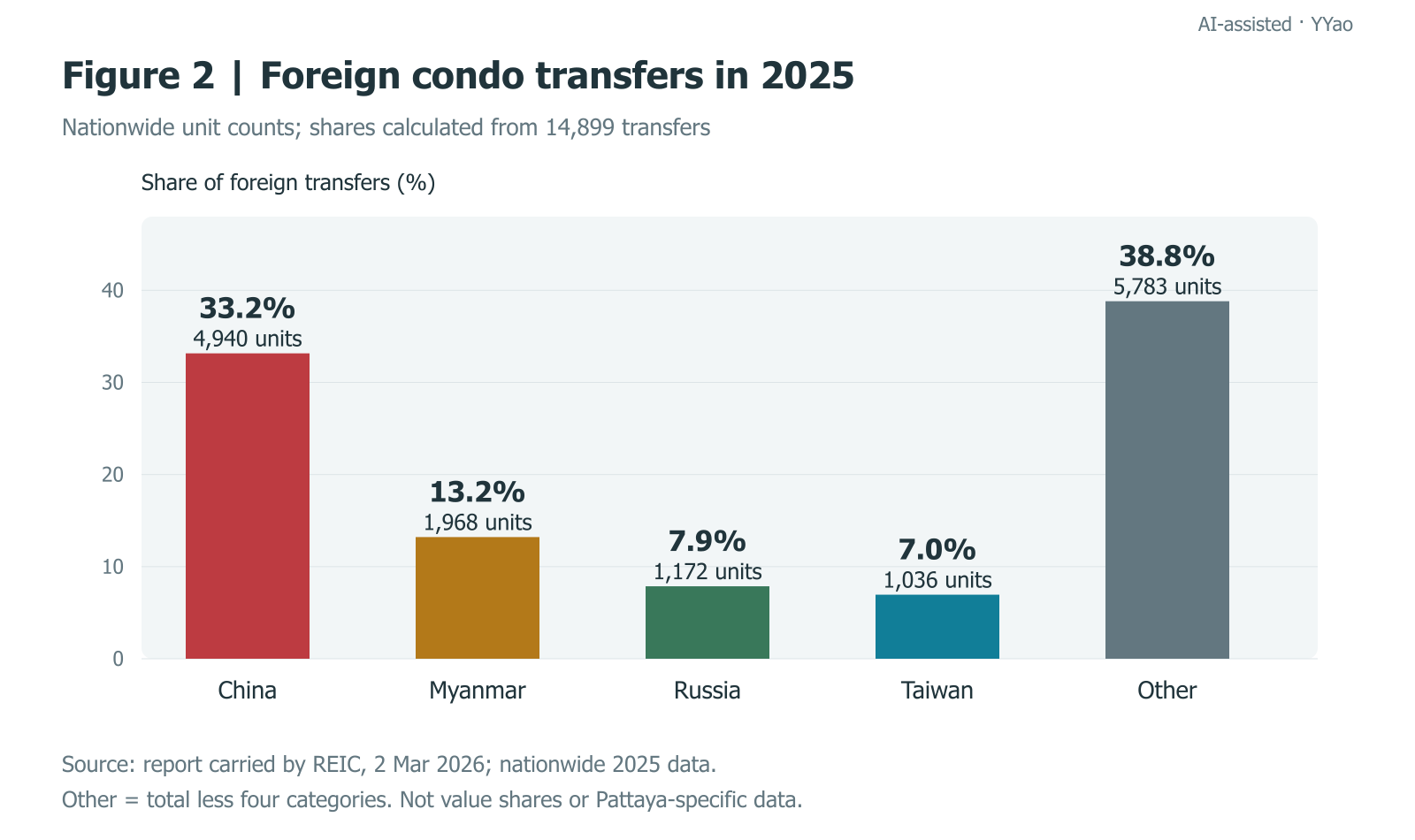
Foreign demand is more diverse, but a changing nationality mix does not prove higher investment returns. Labour migrants, refugees and financially qualified homebuyers cannot be combined into a single purchase-demand estimate.
For agents, a customer’s budget, ability to pay, residency arrangements, preferred area and intended use are more informative than broad assumptions based on nationality.
What support is there for Thai home buyers in 2026–2027?
The Bank of Thailand extended its temporary loan-to-value (LTV) relaxation to 30 June 2027, allowing up to 100% LTV for qualifying new housing loans. It does not guarantee approval: income, debt, credit and collateral checks still apply, and it does not mean foreign buyers qualify for full financing.
The LTV relaxation has been extended; it does not guarantee loan approval.
The Bank of Thailand announced on 14 May that its temporary loan-to-value relaxation would be extended to 30 June 2027. The relevant categories include second and subsequent housing-loan contracts for collateral worth less than THB 10 million, and first and subsequent contracts for collateral worth THB 10 million or more. For qualifying new contracts from 1 July 2026 to 30 June 2027, the applicable LTV ceiling is 100%. [4]
Income, debt, credit and collateral checks still apply. This does not mean that foreign buyers generally qualify for full financing. Registration-fee incentives are a separate policy: their thresholds must not be conflated with LTV rules or included in return calculations before eligibility is checked.
Use a dated economic forecast rather than carrying forward an old figure.
The central bank’s forecast table dated 24 June projected GDP growth of 2.3% in 2026 and 1.8% in 2027. Its 26 August decision maintained the policy rate at 1.00%, noting that growth remained low and uneven and that household consumption was under pressure. [5][6]
Energy costs, tourism, household income and credit conditions deserve monitoring. A national GDP growth rate cannot be converted directly into a city’s condominium price appreciation.
Infrastructure progress is not the same as realised housing demand.
A contractor announcement in May 2026 described work on U-Tapao’s second runway and taxiways; AIIB also provides information on the expansion project. Progress supports a longer-term assessment, but the aviation city, transport links, business occupancy and employment need not materialise at the same time. [7][8]
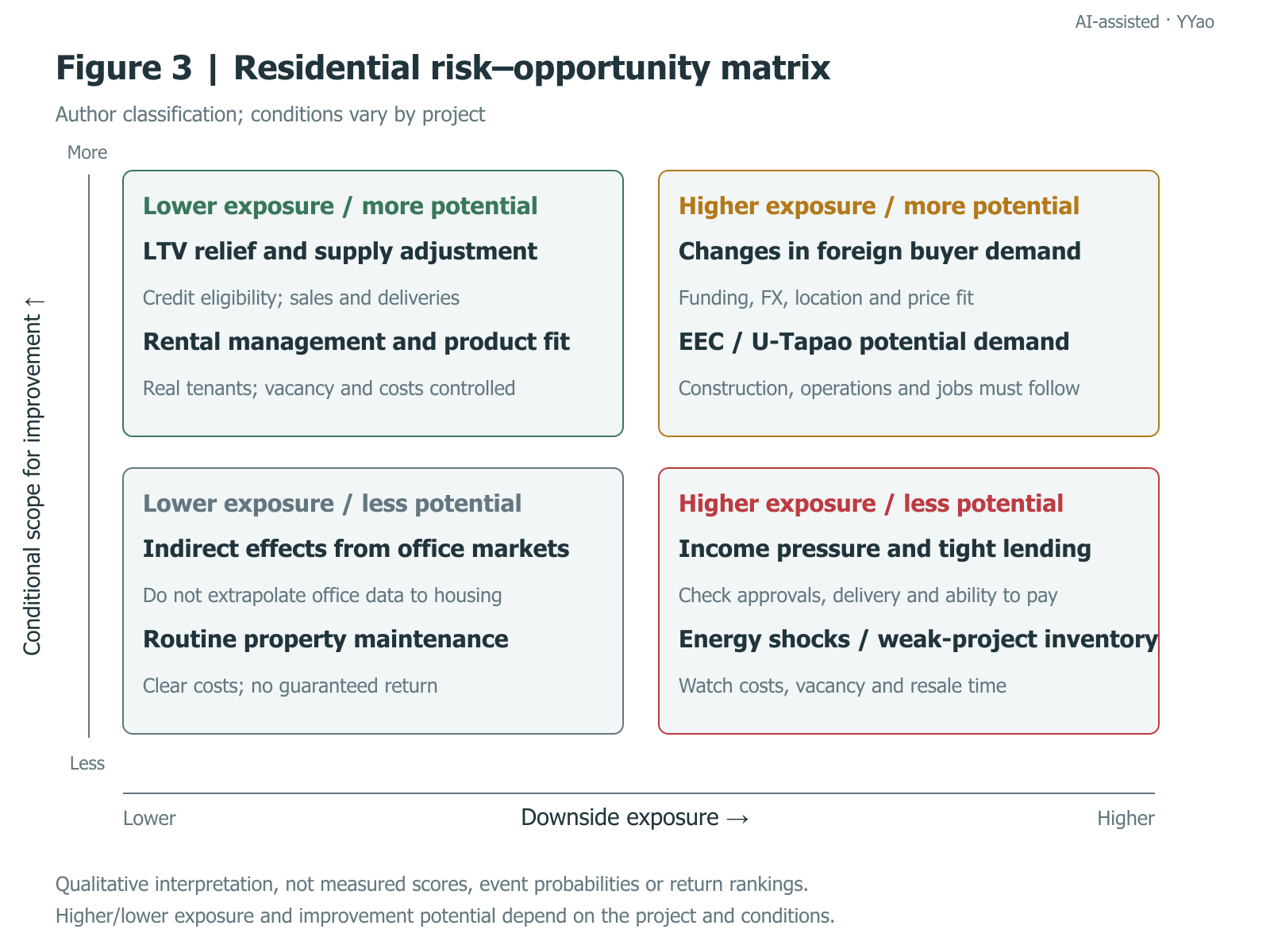
Political developments should be assessed through budget execution, policy continuity, infrastructure contracts and transaction confidence. Opinion-poll rankings are not parliamentary seat counts, and a change of government does not mechanically imply a new election or falling property prices.
What could happen to Thailand’s housing market in Q4 2026?
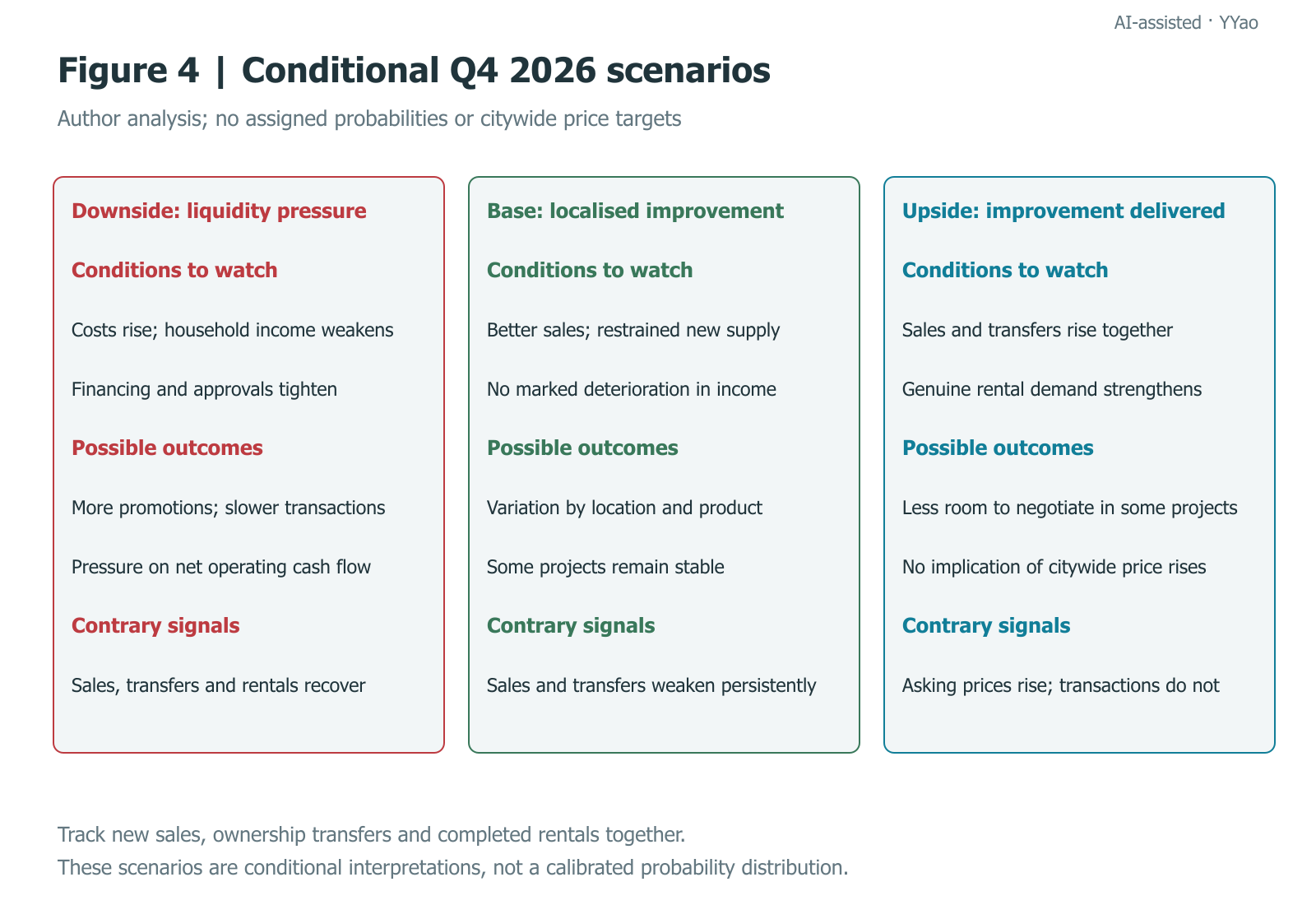
Three conditional paths: localised improvement continues (base case); weaker purchasing power and tighter credit bring more promotions and slower sales (downside); or better sales turn into transfers and rentals, narrowing negotiating room in some projects (upside). No probabilities are assigned.
Base case: localised improvement continues. If condominium sales keep improving, new supply remains restrained and household income and loan approvals do not deteriorate materially, projects supported by employment and commuting demand may be relatively stable. Condominiums and low-rise housing may follow different paths.
Downside case: purchasing power and liquidity weaken again. If energy costs rise, income weakens or financing tightens, promotions may increase and transaction times may lengthen. Projects dependent on high occupancy require particular attention to net cash flow.
Upside case: better sales turn into transfers and rentals. If sales, ownership transfers and genuine rental demand improve together, negotiating room may narrow in some projects. That still would not demonstrate a citywide price increase.
Pattaya especially requires project-level analysis. Jomtien, Na Jomtien, Wongamat and Pratumnak each contain substantial variation. Views, amenities, management, asking price and competing supply all influence performance. Without comparable inventory and absorption data for the same area and property type, it is not reasonable to declare that an entire district needs ten years to clear its stock.
How should you judge rental returns on a Thai condo for 2027–2028?
Look at net cash flow rather than a headline price target. In this article’s hypothetical example, a THB 4 million unit rented at THB 18,000 a month for ten months a year yields 4.5% gross and 3.6% net before financing; with only eight rent-paying months, the net yield falls to 2.7%.
Over the next two years, I will monitor whether lower supply coincides with a genuine recovery in transactions, whether rents cover ownership expenses, and whether transport and industrial expectations translate into tenants and jobs.
Returns require a distinction between gross yield and net operating yield.
Gross yield = actual annual rent collected ÷ total acquisition cost.
Net operating yield before financing = (actual rent collected − operating expenses) ÷ total acquisition cost.
Operating expenses include common-area charges, repairs, letting and management fees, taxes and similar costs. Interest, principal repayments and exit costs should be shown separately. Principal repayment affects cash flow but is not an operating expense.
Suppose total acquisition cost is THB 4 million, monthly rent is THB 18,000, rent is collected for ten months and annual operating expenses are THB 36,000. Gross yield is then 4.5%, and net operating yield before financing is 3.6%. With only eight rent-paying months, the latter falls to 2.7%.
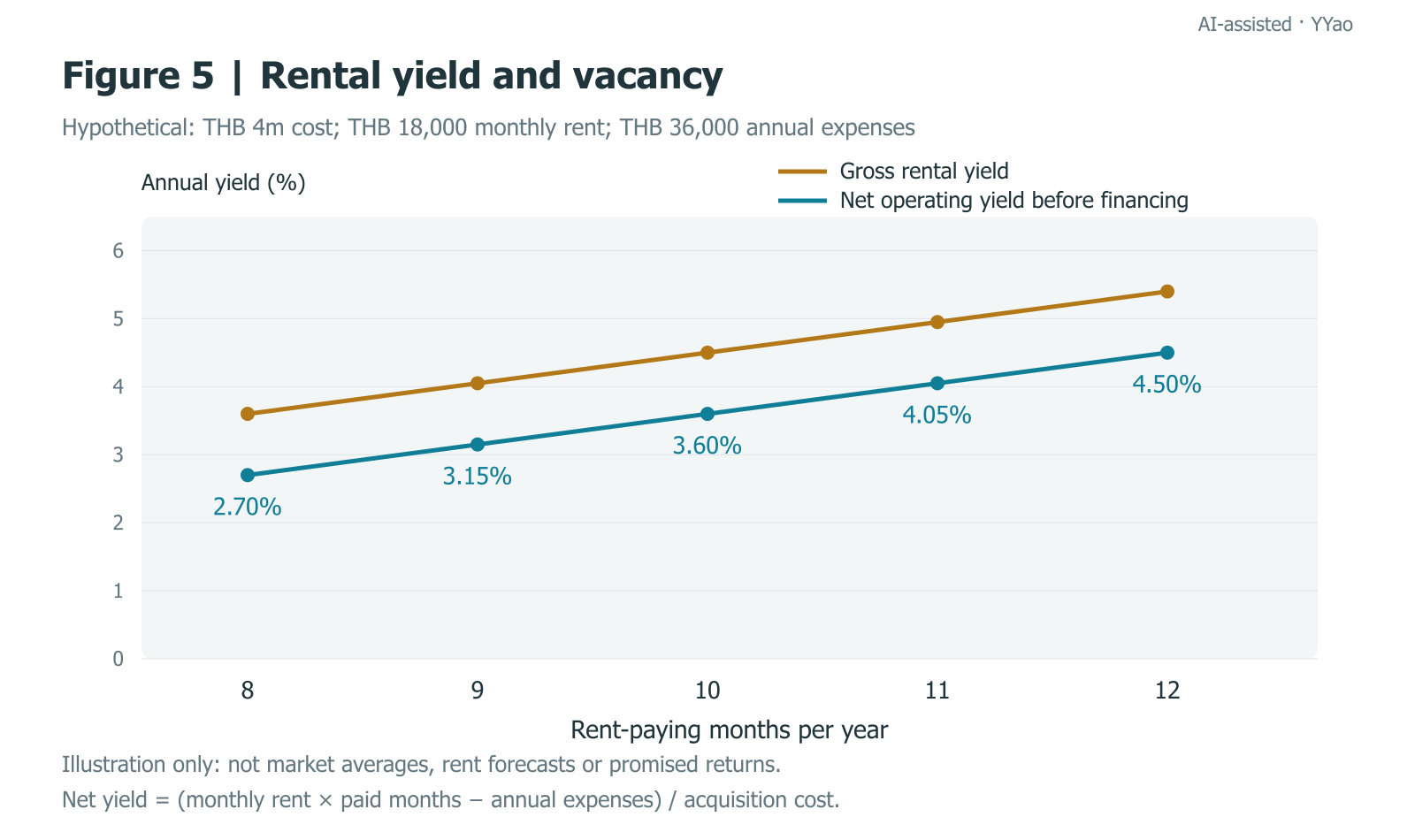
Landlords should check signed rents for comparable units in the same building, vacancy periods and ownership costs. Agents should confirm listing availability, owner authorisation and buyer funding readiness. Owner-occupiers should compare total living costs and commuting. Investors should test net cash flow and actual resale transactions.
Short-term rental operations and foreign ownership also involve specific eligibility and property conditions. This article does not confirm compliance for any particular project or arrangement.
Is now a good time to buy property in Thailand? My view
It depends on the individual project, not the whole market. There is evidence of improvement in some segments, but it must be confirmed by new sales, ownership transfers and completed rentals together, so check the specific building’s rents, vacancy and costs before relying on any appreciation forecast.
There is evidence of improvement in some segments. Its durability still needs to be confirmed by new sales, ownership transfers and completed rentals together.
For ThaiHomeRB, the most useful work at this stage is improving listing accuracy and completeness: clearly describing location, budget, intended use and contact information, and promptly removing properties already rented or sold. A database of asking listings must not be presented as a transaction-price index.
Rely less on a single appreciation forecast and investigate the individual project more closely. That is the starting point for my assessment of Q4 and the following two years.
Sources
[1] Knight Frank, 27 August 2026: Bangkok condominium launch reservation rates. https://www.knightfrank.co.th/blog/amp/2026/08/27/bangkok-condo-sales-rate-improves-to-517-as-developers-target-established-demand?host=www.knightfrank.co.th
[2] REIC press release, 23 September 2026: Q2 sales and supply in Bangkok and surrounding provinces. https://www.reic.or.th/Activities/PressRelease/292
[3] Report carried on REIC’s website, 2 March 2026: foreign condominium transfers in 2025. https://www.reic.or.th/News/RealEstate/470678
[4] Bank of Thailand, 14 May 2026: extension of the temporary LTV relaxation. https://www.bot.or.th/content/dam/bot/documents/th/news-and-media/news/2026/news-20260514.pdf
[5] Bank of Thailand: economic outlook table, version dated 24 June 2026. https://www.bot.or.th/en/thai-economy/economic-outlook.html
[6] Bank of Thailand: monetary policy decision, 26 August 2026. https://www.bot.or.th/en/news-and-media/news/mpc/news-20260826-KsecaE98.html
[7] Italian-Thai, 29 May 2026: U-Tapao construction announcement. https://www.itd.co.th/news-itd-detail.php?news=5303
[8] AIIB: U-Tapao second runway and taxiway expansion project. https://aiib.org/en/projects/details/2022/approved/Thailand-U-Tapao-International-Airport-Expansion-Project.html
Author: Yao Xiang | Pen name: YYao. AI-assisted writing and charts. Reported data, hypothetical calculations and the author’s interpretation are distinguished in the text. Research cutoff: 5 October 2026. This is market commentary, not a return guarantee for any individual project.
ThaiHomeRB | www.thaihomerb.com